





















.jpg?la=es-ES&h=320&w=720&hash=A8D816E00FE95D8222BEAD1891EA6403)














.jpg?la=es-ES&h=310&w=720&hash=AC950E71D9E75EA3384F9FA33A4BC4BC)


.jpg?la=es-ES&h=320&w=719&hash=C7F93ACCBFCF3B3543BF4EA625D0FFF7)
.jpg?la=es-ES&h=306&w=720&hash=C60E61ACE12DC774AED0A36310A41692)

.png?la=es-ES&h=320&w=720&hash=D544A7242A5F779FD0AFB89098709E87)










Eficiencia Energética en Edificios Comerciales: Que Puede Hacer la Automatización por su Factura

A complete guide for UK facility managers: how a BMS works, what it controls, and how Johnson Controls helps commercial buildings reduce energy consumption and operational costs.
For facility managers overseeing commercial buildings in the UK, staying in control of heating, ventilation, lighting, security and fire safety systems is a constant operational challenge. A building management system brings all of these into a single, centralised platform—reducing the time spent on manual checks and giving teams the real-time data they need to make faster, better-informed decisions.
A building management system is central to building automation and controls, connecting the mechanical and electrical systems that keep a building running safely and efficiently. Whether you are managing a single commercial office or a multi-site estate, a BMS provides the monitoring, control and automation capabilities that reduce energy consumption and extend the working life of installed equipment.
This guide explains what a BMS is, how it works, the systems it controls, and the benefits it delivers for commercial building operations.
What Is a Building Management System?
A building management system (BMS) is a computer-based control system that monitors and manages a commercial building's mechanical, electrical and electromechanical services from a single centralised interface. In simple terms, it connects the systems that keep a building running—HVAC, lighting, security, fire safety and energy monitoring—and gives facility managers real-time visibility and control over all of them.
A BMS is also referred to as a building automation system (BAS) or a building energy management system (BEMS), although these terms carry slightly different meanings. See the section on BMS vs BAS vs BEMS below for a full breakdown.
In larger commercial buildings, a BMS removes the need for facility management teams to physically visit every floor, plant room or zone to check or adjust equipment. Instead, control and monitoring happens from a central dashboard - accessible on-site or remotely via cloud-based platforms.
How a Building Management System Works
A BMS operates across three interconnected levels: the field level, the automation level, and the management level. Understanding this architecture helps facility managers assess whether a system will meet their operational requirements.
1. Field level
The field level is where data enters the system. Sensors throughout the building - measuring temperature, humidity, occupancy, airflow and electrical consumption - feed real-time readings into the BMS. Actuators at this level receive control signals and physically adjust equipment: opening or closing valves, adjusting HVAC dampers, switching BMS controls for lighting circuits, and managing access control points
2. Automation level
Direct Digital Controllers (DDCs) sit at the automation level. They receive data from field-level sensors, compare it against pre-set operational parameters and setpoints, and issue control commands to actuators. For example: if a temperature sensor reports the building is below setpoint, the DDC triggers the heating system to respond. This closed-loop process runs continuously without manual input.
3. Management level
The management level is the human interface - a graphical dashboard that presents real-time data from across the building in visual formats. Facility managers can view system status, acknowledge alarms, adjust schedules and setpoints, and extract reports for energy consumption tracking, regulatory compliance and ESG reporting. Modern BMS platforms provide cloud-based remote access, allowing teams to monitor and respond from any location.
Key Systems a Building Management System Controls
A BMS integrates and manages all major building services. The specific systems included depend on building size, age and operational requirements, but typically cover:
| Building System | What the BMS Controls |
|---|---|
| HVAC | Temperature, airflow, pressure and humidity across heating, cooling and ventilation systems |
| Lighting | Automated scheduling, occupancy-based dimming and energy monitoring |
| Fire Safety | Monitoring of fire alarms, smoke detectors and suppression systems |
| Security & Access Control | CCTV integration, access management and real-time entry monitoring |
| Energy Meters | Sub-metering of gas, electricity and water consumption |
| Hot & Chilled Water Systems | Pump operations, temperature regulation and distribution monitoring |
Benefits of Implementing a Building Management System
Reduced energy consumption
A modern BMS can reduce energy consumption by 15-30% by automating HVAC and lighting based on occupancy and real-time conditions rather than fixed schedules. For commercial buildings with significant energy spend, this translates directly into lower operating costs and measurable progress against sustainability targets.
Improved occupant comfort
By continuously regulating temperature, air quality and lighting across all zones, a BMS maintains consistent conditions throughout the working day. This reduces tenant complaints, supports employee productivity and demonstrates a clear commitment to building quality - relevant for both landlords and occupier retention.
Lower operational costs and extended equipment life
Centralised monitoring identifies faults early, before they become expensive failures. Automated scheduling reduces overuse of equipment and supports predictive maintenance programmes - where trend data flags degradation before a system fails. This extends asset life and reduces unplanned maintenance spend.
Regulatory compliance
A BMS supports adherence to UK building regulations, fire safety requirements, energy efficiency standards (MEES and EPC ratings) and ESG reporting obligations. Automated data logging provides an accurate audit trail without manual record-keeping.
Data-driven decision making
Detailed consumption data, alarm histories and performance benchmarks from a BMS inform capital planning decisions, maintenance scheduling and investment justification - giving facility managers evidence rather than estimates.
BMS vs BAS vs BEMS: what is the difference?
The terms BMS, BAS and BEMS are often used interchangeably, but they have distinct meanings. A building energy management system (BEMS) focuses specifically on energy monitoring and optimisation, while a BAS (building automation system) is a broader term common in North American markets. In UK commercial buildings, BMS is the most widely used term.
| Term | Primary Focus | Typical Use |
|---|---|---|
| BMS | Centralised control of all mechanical and electrical building systems | UK commercial buildings - the standard term |
| BAS | Automation of HVAC, lighting and access systems | US and international markets - often synonymous with BMS |
| BEMS | Energy monitoring, optimisation and consumption reporting | Energy management and compliance reporting focus |
UK regulatory requirements for building management systems
UK building regulations do not require a BMS by name, but they do mandate specific energy performance and control outcomes that, in practice, make a BMS the standard compliance solution for larger commercial buildings.
UK landlords operating commercial properties are also subject to Minimum Energy Efficiency Standards (MEES), which require buildings to meet minimum EPC ratings to be let legally. A BMS provides the operational data and consumption controls to support improved EPC performance and demonstrate compliance.
What to look for when choosing a building management system
When evaluating building management system companies, UK facility managers should assess the following factors:
- Open protocols: BACnet and Modbus support allow integration with equipment from multiple manufacturers and protect against vendor lock-in.
- Scalability: Can the system grow with your portfolio? Cloud-based platforms support multi-site monitoring from a single dashboard.
- Energy monitoring depth: Some BMS platforms provide high-level control but limited sub-metering. Confirm the reporting detail matches your energy management and regulatory compliance needs.
- Remote access: Cloud-based access allows your team to monitor and respond to alarms or adjust setpoints without being on-site.
- Integration with CAFM and IWMS: A BMS that connects with your facilities management software creates a unified operational view across maintenance, space and energy data.
- Cybersecurity: As BMS platforms become more networked, secure remote access, network segmentation and IT alignment are essential requirements.
Frequently asked questions
What does a building management system do?
A BMS monitors and controls a commercial building's mechanical and electrical systems - including HVAC, lighting, fire safety and security - from a centralised platform. It reduces energy consumption, supports regulatory compliance and gives facility managers real-time visibility of building performance.
How much does a building management system cost?
BMS costs vary significantly based on building size, system complexity and the scope of integration required. New-build installations are typically lower cost than retrofits into older buildings with legacy systems. Operating costs are usually offset over time through energy savings and reduced maintenance spend.
What is the difference between a BMS and BEMS?
A building energy management system (BEMS) focuses specifically on energy monitoring and optimisation. A BMS is a broader platform that also controls HVAC, security, fire safety and other building services. BEMS functionality is often included within or layered on top of a full BMS.
What communication protocols does a BMS use?
The most common protocols are BACnet (Building Automation and Control Networks) and Modbus. Both allow devices from different manufacturers to communicate on the same network. Choosing an open-protocol BMS avoids dependency on a single supplier.
Is a building management system mandatory in the UK?
UK regulations do not require a BMS by name, but buildings above 180 kW heating or cooling output must meet control and automation requirements (BACS) under building regulations. A BMS is the standard way to meet these requirements in commercial buildings.
Explore Johnson Controls building automation and controls
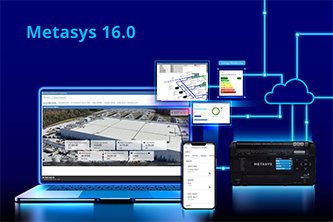
Johnson Controls has delivered building automation and controls solutions for commercial buildings across the UK and globally for decades. Our Metasys Building Automation System gives facility managers centralised control, real-time energy monitoring and the integration capabilities to connect HVAC, security, fire safety and lighting into a single operational platform.
Whether you are planning a new installation, upgrading a legacy system or looking to improve energy efficiency across a multi-site estate, our team can help. Explore our building automation and controls solutions.